AI
The Anti-Hype Playbook: Exactly How to Use AI Tools to Grow a Small Business
May 15, 2026
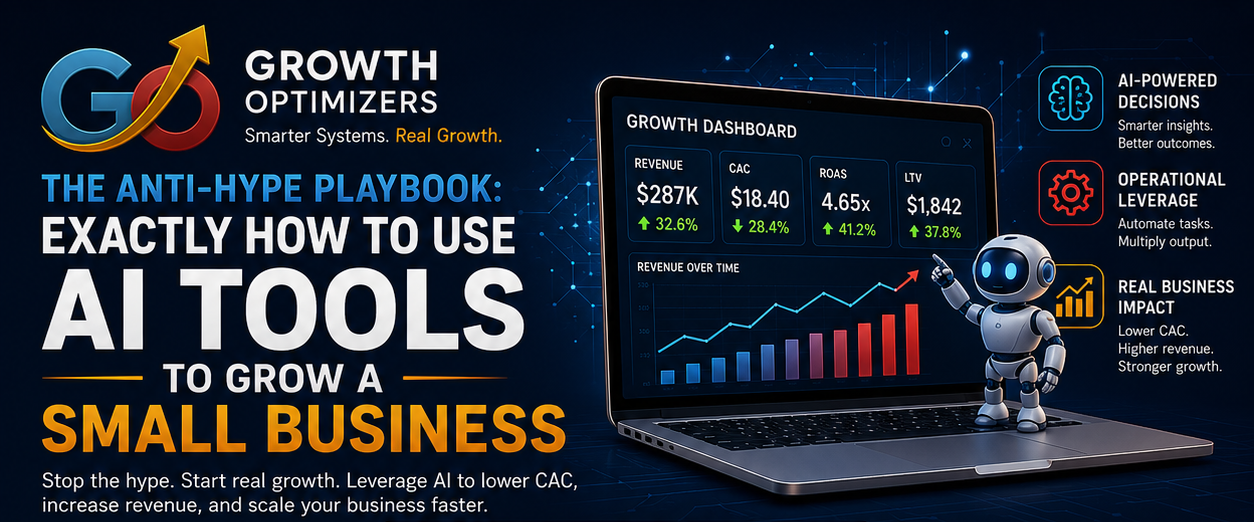
Right now, your LinkedIn feed is likely flooded with self-proclaimed gurus promising that Artificial Intelligence will magically double your revenue overnight. Their standard advice usually revolves around using ChatGPT to write hundreds of generic social media posts or churn out soulless SEO articles. Let’s be completely honest: creating more frontend noise is not a growth strategy. In fact, if everyone is using the exact same generative models to write the exact same content, you are just blending into an ocean of mediocrity.
If you are a founder or an operator trying to figure out how to use AI tools to grow a small business, you have to look past the marketing hype. The true power of modern AI is not in content generation; it is in operational leverage. It is about taking a lean team of five people and giving them the backend output capacity of a fifty-person enterprise. It is about actively plugging the leaks in your sales funnel, drastically lowering your Customer Acquisition Cost (CAC), and accelerating your speed to market.
At Growth Optimizers, we don't care about vanity metrics. We care about systems that move the needle. Here is the exact, unvarnished diagnostic and implementation playbook we run to inject artificial intelligence into small business tech stacks, turning them into highly efficient revenue engines.
The Illusion of the "AI Marketer" vs. The Reality of Operational AI
Before we dive into the tactics, we need to separate the toys from the tools. Using an LLM (Large Language Model) to draft an email is a toy. Using an AI agent to scrape 1,000 target accounts, identify which ones just hired a new VP of Sales, and automatically draft hyper-personalized outreach to those specific decision-makers is a tool.
Small businesses typically fail because they run out of time or cash before they find product-market fit. Operational AI gives you back both. When deployed correctly, it acts as a force multiplier across your three most critical revenue departments: Outbound Sales, Conversion Rate Optimization (CRO), and Customer Success.
Phase 1: Re-engineering Outbound Sales (The AI SDR)
The traditional B2B outbound playbook is broken. Hiring a junior Sales Development Representative (SDR) costs upwards of $72,000 a year, plus benefits, software licenses, and months of onboarding. We ran the math on this extensively: an entry-level human spending eight hours a day copy-pasting LinkedIn templates cannot compete with a $99/month AI agent.
Here is how you actually build an autonomous pipeline:
1. Waterfall Data Enrichment
Do not buy static lists from data brokers. They are outdated the second you download them. Instead, use AI-driven enrichment tools (like Clay). You start with a basic list of domains, and the AI agent automatically cross-references them against dozens of data providers to find the most accurate emails, recent company news, and technological footprints (e.g., checking if they just installed a specific competitor's software on their website).
2. Trigger-Based Personalization
Nobody responds to "Hope you are doing well." Small businesses win by being hyper-relevant. You can program an AI to monitor your enriched list for specific buying signals. Did a target company just announce Series A funding? The AI detects the press release, extracts the context, and automatically drafts an email referencing that exact funding round to pitch your solution.
The TL;DR: AI handles the top-of-funnel grunt work. The human sales rep only steps in when a warm prospect replies, allowing your team to focus exclusively on nuance, negotiation, and closing the deal.
Phase 2: Plugging Funnel Leaks with Conversion Intelligence
Most teams do not have a traffic problem; they have a leak problem. You are paying top dollar for Google and Meta ads, but your landing page is quietly bleeding potential buyers. AI tools are uniquely equipped to diagnose and repair these invisible leaks faster than any human marketing team.
Synthesizing the Voice of the Customer
Your best copywriting material is currently trapped in the cloud. It lives inside your Zoom call recordings, Gong transcripts, and customer support tickets.
Instead of guessing what your landing page hero copy should say, dump the transcripts of your last 100 sales calls into an advanced LLM like Claude 3.5 or GPT-4. Ask the AI: "What are the top three specific objections prospects mention before deciding not to buy? Give me the exact phrases they use."
Once the AI synthesizes this data, you update your landing page to address those exact objections using your customers' exact words. This instantly drops friction and lowers your CAC because the copy resonates on a psychological level.
Dynamic Traffic Routing and Attribution
Bad attribution kills scaling efforts. If you don't know which ad genuinely drove the sale, you are burning cash. Modern AI analytics tools can model complex, multi-touch attribution paths, telling you precisely which touchpoints are actually driving high Lifetime Value (LTV) customers. Furthermore, AI can dynamically adjust your landing page headlines based on the exact search term the user clicked, ensuring maximum relevance from click to conversion.
Phase 3: Automating Customer Success and Churn Reduction
Acquiring a new customer is roughly five times more expensive than retaining an existing one. Yet, small businesses routinely let customers churn because their support queues are backlogged. If a customer has to wait 48 hours for a simple password reset or shipping update, they are leaving.
Deploying the Triage Agent
Do not replace your human support team; put an AI triage agent directly in front of them. Roughly 80% of inbound support tickets are highly repetitive, low-tier questions.
By training an AI agent on your internal knowledge base, past support tickets, and shipping databases, it can instantly resolve those repetitive queries 24/7. This creates a massive operational advantage:
Instant Gratification: The customer gets their problem solved in four seconds instead of four hours.
Human Capital Reallocation: Your actual human support staff is completely freed from answering "Where is my order?" They can now dedicate 100% of their time to high-value proactive retention, onboarding high-tier clients, and driving upsells.
Phase 4: The 5-Day Squad Implementation
The biggest mistake small business owners make when exploring how to use AI tools to grow a small business is treating it like a massive, multi-quarter digital transformation project.
Six months to ramp up an initiative equals six months of lost compounding growth. Speed is everything. You do not need to wait two quarters for a traditional enterprise agency to map out a bloated strategy.
At Growth Optimizers, we believe in the "5-Day Squad" model. You parachute a highly specialized senior team directly into your current tech stack. You identify the single biggest bottleneck whether it is an empty sales pipeline, a leaky checkout funnel, or a backlogged support desk and you deploy a targeted AI agent to fix that specific problem within a week.
Get the system live, let it process real-world data, and iterate immediately. The learnings you gather in the first 30 days of a live AI deployment will dictate the trajectory of your entire revenue curve for the next 12 months.
Conclusion: Stop Waiting for Permission
The barriers to entry for enterprise-grade technology have effectively been reduced to zero. Five years ago, implementing natural language processing and automated data enrichment required a million-dollar budget and an in-house team of engineers. Today, a scrappy small business can string together three SaaS tools for a few hundred dollars a month and outmaneuver a Fortune 500 competitor.
The true competitive advantage is no longer access to technology; it is the velocity of implementation.
If you want to drastically drop your CAC, build an autonomous pipeline, and scale your operations without exploding your payroll, you have to embrace backend automation. Stop focusing on generating more noise, and start engineering an infrastructure built for relentless, compounding speed.
Frequently Asked Questions (FAQs)
1. Do I need to know how to code to implement AI in my small business?
No. The vast majority of operational AI tools today utilize "no-code" or "low-code" interfaces. Platforms like Zapier, Make, and Clay allow you to build incredibly complex, automated AI workflows using simple visual drag-and-drop builders.
2. Is it safe to feed my company data into an AI tool?
It depends entirely on the tool and your settings. You must ensure you are using enterprise-tier licenses that explicitly state your data will not be used to train their public models (Zero Data Retention policies). Never put sensitive customer PII (Personally Identifiable Information) or proprietary financial data into a free, public chatbot.
3. What is the fastest way to see an ROI from AI implementation?
The fastest ROI consistently comes from top-of-funnel outbound automation. By replacing expensive, manual list-building and initial cold email drafting with an AI enrichment workflow, you immediately reduce your cost-per-lead and dramatically increase your daily outreach volume within the first week.
4. Will AI agents completely replace my human sales and support staff?
No. AI lacks empathy, nuance, and the ability to negotiate complex B2B deals. AI should be viewed as an exoskeleton for your human team. It handles the high-volume, low-value administrative grunt work, allowing your human staff to operate at the top of their intelligence.
5. How much does a basic AI operational stack cost for a small team?
You can build a highly effective, automated outbound and support stack for under $500 a month. This typically includes a premium ChatGPT/Claude subscription, an automation platform like Make.com, a data enrichment tool like Clay, and an AI-powered inbox management software. The return on that investment is usually realized within the first closed deal.
The week holds 5 seats. No more.
We cap the intake on purpose small rooms, sharper acoustics. Make the cut and you get a desk inside the system that's already moved millions in pipeline.
Door policy · You're on the list if
What's in the envelope
Worth $299 · FreeFree Growth Blueprint Call
- A full funnel walkthrough every floor, every leak named out loud
- We point at the line items quietly setting fire to your growth
- A 30-60-90 day roadmap, drafted in your handwriting, yours to keep