AI
Level the Playing Field: Architecting a Dominant AI marketing strategy for small business
May 25, 2026
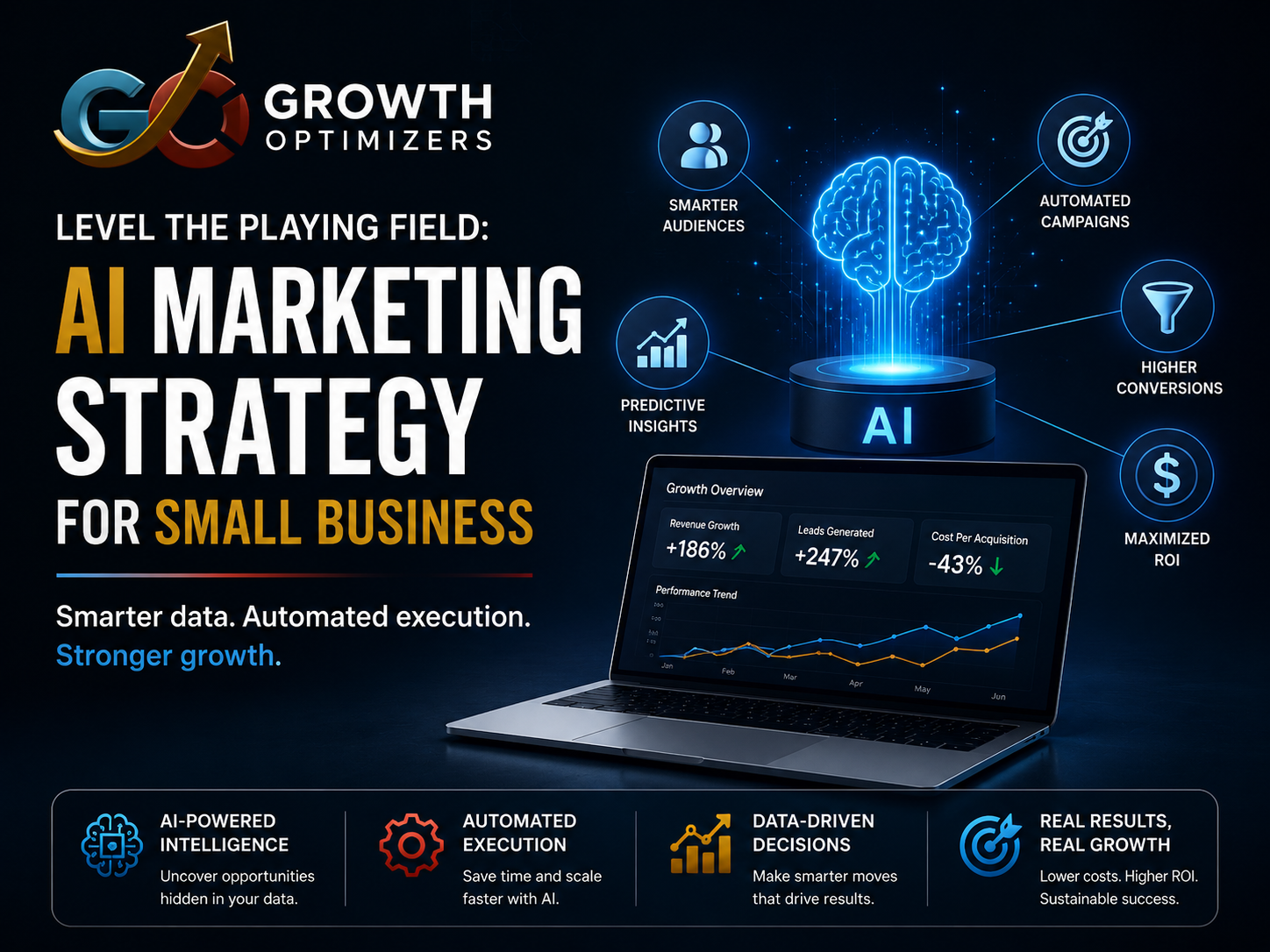
For decades, the fundamental rule of business growth was brutally simple: the company with the biggest marketing budget won. Enterprise corporations possessed the financial capital to hire sprawling departments of data scientists, elite copywriters, and media buyers to dominate the digital landscape. Small and mid-sized businesses, armed with limited resources and constrained bandwidth, were often left fighting over the remaining scraps of market share.
In 2026, that historical paradigm has completely shattered.
The rapid maturation of Artificial Intelligence has fundamentally democratized the digital economy. Today, a five-person startup can execute complex, multi-channel campaigns with the exact same precision and volume as a Fortune 500 company. However, simply buying an AI subscription or using a generative text prompt is not a strategy. To truly capture market share, you must integrate these technologies into a cohesive, aggressive revenue engine.
If your company is still relying on manual data entry, "gut feeling" ad budgets, and static email blasts, you are actively subsidizing your competitors’ success. At Growth Optimizers, we specialize in dismantling outdated workflows. We replace them with autonomous, highly scalable systems.
Here is a comprehensive, deep-dive blueprint on how to build a ruthless, ROI-obsessed AI marketing strategy for small business, and how our team engineers the infrastructure required to help you punch far above your weight class.
The Democratization of Data: Why AI is the Ultimate Equalizer
To understand the power of an AI marketing strategy for small business, you must first understand the concept of operational leverage. In the past, if you wanted to double your marketing output, you had to double your payroll. You had to hire more graphic designers, more media buyers, and more customer service representatives.
AI removes this linear barrier to growth. It allows you to decouple your revenue potential from your headcount.
When correctly implemented, AI acts as an autonomous digital workforce that operates 24 hours a day, 7 days a week, without fatigue. It analyzes vast datasets to uncover hidden purchasing patterns, generates hyper-personalized creative assets at scale, and adjusts your advertising bids in milliseconds based on shifting market dynamics. It takes the tedious, administrative grunt work off your plate, allowing your human talent to focus exclusively on high-level strategy and relationship building.
The 4 Pillars of an AI marketing strategy for small business
Implementing AI is not about randomly plugging disparate tools into your workflow. It is about creating a unified, synchronized ecosystem. A dominant strategy relies on four foundational pillars.
1. Predictive Analytics and Audience Segmentation
Traditional marketing is inherently reactive; you analyze a past campaign to see what worked, and then try to replicate it. AI transitions your marketing from reactive to predictive.
By integrating machine learning algorithms with your Customer Relationship Management (CRM) platform, AI analyzes thousands of micro-interactions how long a user watched a specific video, which links they clicked in an email, and their past purchasing frequency. The system then automatically segments your audience based on their exact likelihood to convert in the near future. Instead of blasting a generic discount code to your entire database, the AI identifies the exact 5% of your list who are "warm" and automatically sends them a highly targeted offer, drastically improving your conversion rates while protecting your profit margins.
2. Autonomous Ad Bidding and Budget Allocation
Managing Google Ads or Meta (Facebook/Instagram) advertising manually is a highly challenging endeavor that often leads to wasted capital. The digital auction moves too fast for a human to optimize effectively.
A robust AI marketing strategy for small business leverages automated, algorithmic media buying. We deploy AI agents that monitor your Cost Per Acquisition (CPA) in real-time. If the algorithm detects that clicks are cheaper on Tuesday mornings for a specific demographic, it will autonomously shift your budget to capitalize on that window. It ruthlessly prunes wasted ad spend on underperforming keywords and reallocates that capital toward your highest-converting audiences, effectively lowering your Customer Acquisition Cost (CAC) while you sleep.
3. Hyper-Personalized Content Generation at Scale
Generic content is ignored by modern consumers. Buyers demand personalization. However, manually writing unique emails, landing pages, and ad copy for dozens of different buyer personas is simply unachievable for a small team.
We utilize advanced Large Language Models (LLMs) deeply trained on your specific brand voice and historical performance data. These models generate highly relevant, dynamic content at an unprecedented scale.
Dynamic Landing Pages: The AI adjusts the headlines and imagery on your website in real-time based on the specific ad the user just clicked.
Contextual Email Sequences: The system crafts personalized follow-up emails that reference the exact product pages a user lingered on, rather than sending a generic newsletter.
4. 24/7 Conversational Lead Capture
Traffic is entirely useless if your website fails to capture the lead. If a highly qualified prospect visits your site at midnight and fills out a static web form, forcing them to wait until the next morning for a human response, that deal will likely go cold. We integrate intelligent, natural-language AI agents that act as your frontline SDRs (Sales Development Representatives). These agents instantly engage the prospect, qualify them based on your exact parameters, enrich their company data, and book a meeting directly onto your sales team's calendar regardless of the hour or time zone.
The Growth Optimizers Implementation Framework
Many small businesses avoid AI because the technical integration feels overwhelmingly complex. At Growth Optimizers, we remove the technical friction. We do not just hand you a list of software recommendations; we act as your dedicated engineering team to build the engine.
Here is our precise rollout methodology:
Phase 1: The Funnel Diagnostic
Before we deploy a single piece of AI technology, we conduct a ruthless audit of your existing data infrastructure. AI is only as intelligent as the data you feed it. We clean your CRM databases, fix broken tracking pixels, and ensure that your lead flow is accurately measured from the first click to the final closed deal.
Phase 2: Tech Stack Integration
We reject bloated software. We select specific, high-leverage AI tools that integrate seamlessly with your existing platforms (such as HubSpot, Salesforce, or Shopify). We connect the APIs, configure the machine learning models to understand your Ideal Customer Profile (ICP), and establish the automated workflows that will drive your campaigns.
Phase 3: The "Human-in-the-Loop" Launch
We never advocate for completely unmonitored automation. AI can occasionally hallucinate or misinterpret a complex nuance. We deploy a strict "Human-in-the-Loop" protocol. The AI handles the heavy lifting data analysis, draft generation, and initial lead qualification but your human team retains final approval authority on creative output and high-level strategic shifts.
Navigating the Pitfalls: What to Avoid
As with any powerful technology, there are significant risks if deployed incorrectly. We actively shield our clients from the common traps that destroy brand equity:
The "AI Slop" Trap: Flooding your blog and social media channels with generic, unedited AI-generated content will severely damage your brand's reputation and trigger heavy SEO penalties from Google. AI must be used to augment your unique thought leadership, not replace it entirely.
Siloed Systems: If your AI ad bidder isn't talking to your AI email nurturer, you have a fragmented customer journey. We ensure your entire tech stack communicates flawlessly via robust API architecture.
Ignoring Data Privacy: As privacy laws (like GDPR and state-level CCPA regulations) become stricter, feeding customer data into open-source AI models is a massive legal liability. We utilize secure, enterprise-grade private models to ensure your proprietary business data and your customers' personal information remain completely protected.
Conclusion: Stop Waiting for Permission to Scale
The technological moat that once protected massive corporations has officially dried up. The tools required to dominate your industry, capture premium market share, and scale your revenue with unprecedented efficiency are now fully available to your organization.
However, technology alone is not a savior. It requires a deliberate, engineered strategy to execute correctly. Implementing a powerful AI marketing strategy for small business is the ultimate catalyst for growth in 2026, transitioning your business from a manual operation into an autonomous revenue engine.
Are you ready to stop fighting an uphill battle and start engineering an unfair advantage in your market? Connect with the growth architects at Growth Optimizers today. Let our team audit your current funnel and build the automated, AI-driven infrastructure you need to command your industry.
Frequently Asked Questions (FAQs)
1. Is an AI marketing strategy too expensive for a small business?
No. In fact, it is significantly cheaper than the traditional alternative. Instead of paying multiple full-time salaries for junior copywriters, data analysts, and media buyers, you are investing in highly efficient software infrastructure and expert strategic oversight, drastically reducing your overall operational overhead.
2. Will AI make my brand sound robotic or lose its "human touch"?
Only if it is poorly implemented. We spend significant time "training" the Large Language Models on your past content, your brand voice guidelines, and your successful sales transcripts. This ensures the output sounds distinctly like your brand, allowing you to maintain your authentic voice at scale.
3. Do I need a highly technical team to manage this once it is built?
No. Our mandate at Growth Optimizers is to build complex systems that are incredibly simple for the end-user to operate. We handle the complex API engineering and algorithm training. Once deployed, we provide your existing team with intuitive dashboards and clear operational playbooks.
4. How quickly can we expect to see an ROI after implementing AI?
While long-term predictive models compound over time, you will typically see immediate efficiency gains within the first 30 days. This comes from instant reductions in wasted ad spend, higher lead capture rates via autonomous agents, and massive time savings in content production.
5. What is the difference between ChatGPT and a true AI marketing strategy?
ChatGPT is simply a singular tool (a text generator). An AI marketing strategy for small business is an interconnected ecosystem. It involves data enrichment APIs, predictive CRM routing, algorithmic media buying, and autonomous sales agents all communicating with each other to autonomously move a prospect from a stranger to a paying customer.
The week holds 5 seats. No more.
We cap the intake on purpose small rooms, sharper acoustics. Make the cut and you get a desk inside the system that's already moved millions in pipeline.
Door policy · You're on the list if
What's in the envelope
Worth $299 · FreeFree Growth Blueprint Call
- A full funnel walkthrough every floor, every leak named out loud
- We point at the line items quietly setting fire to your growth
- A 30-60-90 day roadmap, drafted in your handwriting, yours to keep